
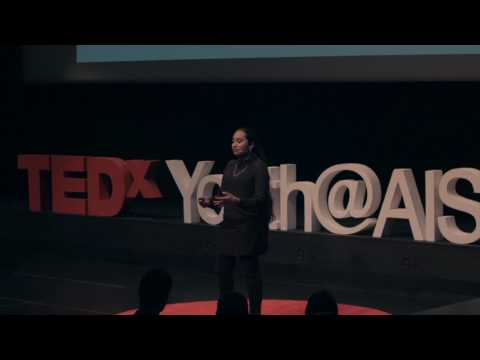
name is hazra holla’d and today i am
going to be talking to you about the
value of identity or alternatively how
to be a forest culture kid and an
educational system so let’s start with
some basic definitions because earth
culture kid might not sound that
familiar to some of y’all since were in
an international school setting though
the terms third culture might ring with
some of you so what is a third culture
kid a third culture kid is simply a
child that grows up and a culture
different than both of their parents so
that begs the question what is a fourth
culture kid I’ll have you know it’s a
self coin term for today but let me just
explain to you instead of a technical
definition let me give you the
experience it’s that cascade of
existential crises that comes with a
question where are you from or if you’re
really lucky where are you really from
so for the first time in my very short
adult life I will allow the audience to
it is so interesting that you ask
actually let me break it down for you so
quickly i am half Trinidadian and
half-pakistani let me break that down
for you some more my mom is ethnically
Trinidadian but she’s from Brooklyn New
York and my dad is from Pakistan and i
was born in riyadh saudi arabia but if
you ask me where home is i would tell
you it’s st. Augustine Florida that kind
of moment of pin drop silence is
actually very common do not worry I get
that a lot so what I really want to talk
to you today though is as a fourth
culture kid how different instances come
up in my life as I go through school and
different educational systems the
different small acts of kind of
microaggressions that students of color
and specifically for culture kids have
to go through so first let me give you
some more definitions what is a micro
aggression well according to psychology
today a microaggression is the either
verbal or nonverbal and either
intentional or non intentional insult
slide or snub that is used to target a
person that subscribes to a marginalized
group of people so that might sound like
a lot out of context but let me give you
an example cuz I have a lot so first
thing what’s in a name well let me tell
you on the first day of eighth grade I
got up I got ready I went to school as
he do and my teacher she asked me you
know what’s your name and I said my name
is Howser holla’d and she went what and
I says he’s like hajjaj no that’s a lot
can i just call you h can i just call
you Hodge and I said no my name is Hera
holla’d and that name was given to me
out of respect from my parents from my
culture and from my religion and it
should never be shortened just because
it’s easier to pronounce second
well before we go there actually these
instances actually happen a lot and can
cause students of color and specifically
fourth culture kids to feel a lot of
disconnect when the proper time and
emphasis is not put in by educators to
understand the ways in which race and
culture affect power structures within
our educational systems this can be seen
within the United States as from the
years 2011 22 2012 over eighty-two
percent of the educators in the
workforce where way whereas only 51
percent of the actual student body
whistle so let me give you a sum a
second example the second example is
kind of a term you might not know but
let me explain it for you it’s called
white splaining it’s basically when a
person of European descent tries to
either explain to or from the point of
view of a person of color their own race
or their own culture and I also have
another example for this it’s when a
teacher that I am very very close to
when I look up to a lot we were just you
know we were just talking and another
teacher comes by and I had my corners
done for Black History Week and he asked
me you know can you please just explain
like what is the difference between
cultural appropriation and cultural
appreciation I was like oh my god yes
I’ve been waiting so yes finally asked
me I’d love to tell you about it and I
kept trying and trying but he kept
talking over me and it got to a point
where the teacher where I’m very close
to how to go well listen what she’s
trying to say is and I was like no my
voice has never felt so insignificant
before we need to stop allowing certain
microaggressions to go without
understanding the implicit real life
situations that can come from them here
is just another example within the
United States where only eighteen
percent of the school population was
black but they made up over thirty nine
percent of explosions this can come from
the common of feeling of disconnect
between students of color and educators
when there isn’t
a always aware our conscious discussion
about race and culture so I have one
final and exit to leave you live and I
know I joked at the beginning you know
where are you really from and a lot of
you got that but it’s actually from when
I was very young and we have a cultural
celebration here at school where you
know we have our flags you know where
we’re from and it’s really cool but that
was already stressful for me as a child
because I didn’t just have one I was
supposed to have four but I only had to
I had to with me it was like America and
Pakistan because you know those are the
ones most people know and um a teacher
came up to me and she said why are you
holding that flag where are you really
from you’re not American and he said
where are you really from and I was like
everywhere I guess I just everywhere but
what I really want you to take from that
is that things that may not seem like a
big deal I actually a really big deal
for kids I have to deal with the really
complex thing which is identity and so
the final thing I want to leave you with
is diversity is not just a concept many
many many institutions are very quick to
boast about their robust and diverse
student community but real real
diversity comes with the education and
understanding put in by both educators
and students to understand the ways in
which race and culture impact our
interactions with each other and how we
can further ourselves within different
educational systems thank you very much [Applause]