
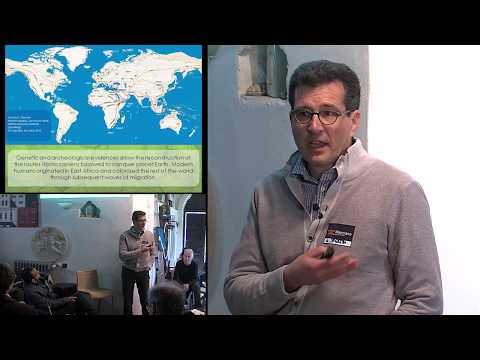
between man and environment humankind
and the natural environment we
originated less than 200,000 years ago
in West Eastern Africa and then about
eighty-five thousand years ago we
started moving toward the rest of the
world in four different waves of
expansions first in Africa and then the
other continents our ancestors
experienced since the beginning a very
deep relationship with nature because
like any other animal we have to cope
with the environment with our
competitors praise predators and so on
so our relationship was very true and
deep and since then this relationship is
is part of us of our nature so many
poets in modern times even in ancient
times artists designers even scientists
were inspired by nature and it’s part of
our way of living quite recently has
been studied the effect of quite
recently has been studied the effect of
nature in in our brain in our behavior
so we know that stain in nature is for
us something that make us healthier
richer and even more creative and has
positive effect on on the brain but
starting from some years ago human
population moved to cities and so we
have we lived more and more indoor and
so the 2007 was the turning point where
roughly fifty percent of human
population starting to live in cities
instead of in in the countryside and
there are some figures that say that in
about nineteen fifty about 30
enter people lived in the county side
but by 2050 maybe roughly seventy
percent of people will live in cities so
the first effect is we have no more
direct contact with nature we are part
of it we depend on it we still depend on
measure like our ancestor depended on
nature but the content is no more
functioning we are just put apart so
what is our relationship with nature
nowadays how are we connected and
looking for some inspiration for this
talk I browse the internet and found a
new concept for me which is neisha
connectedness is the extent to which we
feel part of nature and can change by
our experience it can change for one
person to another it’s like a character
and some studies has been done in this
sense and the three main components of
nature connect pneus are the three here
which is a cognitive component how I I
feel part of nature it’s a component of
affective component individual sense of
care for nature and a behavioral
component I am committed to do something
to preserve nature all these three made
this concert I started my career as our
life biologist as I still am working on
the field on wild mammals and wild birds
and at a certain point I felt that
something was missing because everything
we were looking for every research were
as not sense if the people were not
connected if we want we don’t have
people part of our joke part of the play
because we need to have a more
engagement of society in what we want to
do to preserve the environment we have
not no more time we have to run so i
came across citizen science citizen
science it’s just the involved
mental people in the scientific
questions in the scientific research in
many different fields is just made up of
involvement participation and feedback
it can give results at different levels
so the citizen science can be the
response and I started working on
citizen science with several colleagues
from Europe mainly and I discover that
citizen science can have different
levels of participation you can just
participate collecting information given
to a researcher which is the contribute
of citizen science or you can play
different rules till the extreme citizen
science which is taking part on all the
stages of research from the first
hypothesis to the publication of the
results and so we know that citizen
science can be applied to many different
fields like medicine biology but
astronomy the study of any field of
modern research and can be applied in
many different ways there are several
examples and it’s a very quickly growing
field this is an example form the USA
where hundreds thousands of people are
collaborating collecting information on
the migration of birds and so it’s
impossible to have the same result with
just few researchers work in the field
it’s possible if you engage all the
people that can help you I want to help
you and and learn about this experience
so these are carried out by the corner
lab of ornithology in ithaca new york
but there is also many european examples
opal is that may be the biggest one in
europe it’s led by the Imperial College
in London and it’s just made up of many
different surveys involving people in
the collection of information about data
quality of water quality soil box count
three health many different fields and
people can can play a big role another
one just forgive you
sample is the mosquito left which is a
way to help researchers to spot the new
species of mosquitoes and you know that
there are some mosquitoes they are
coming from other countries and some of
them are bringing diseases so it’s very
important to spot them on time and there
are many several other experiences made
and the process behind a citizen science
project it’s the same of that of a
science project so it’s like identifying
what you would like to to study find out
the the best solution to do it the best
experts and find the the tools for do it
collect an information evaluating them
and then at the end publishing the
results so it exactly the same of real
science it’s real science and so we
started to do that at our natural
history museum which is based on in
grosseto south and most part of Tuscany
and it’s a small original Museum and we
wanted to to put people in contact with
nature and so bring the museum outside
and let the people doing the both the
experience within the museum and
collecting information outside it was
nowadays is is the our mainstream many
activities was shaped for this purpose
so we started doing bio places which are
experiences of 24 hours on the field
even during night involving researchers
and regular public in collecting
information on the biodiversity of a
certain place or courses for citizen
scientists and and so on so we provide
many different tools to people and the
response was quite interesting and these
are some results some reports for the
information we collected some lift
sheets that that we give to the people
to go in the field to collect
information and we also had some
scientific papers published in
international journals on in this case
that is
tribution at the national level of the
crested porcupine for example and we had
also the fortune to be part of the small
group of people that starting
establishing the European citizen
science association some years ago that
was established in 2014 and then now the
European citizen science association is
quite a white one with members from
different parts of the globe and we are
actively working and almost in the same
period even in the USA and Australia a
tattoo large associations born and so
now we are three Association working
together at a global scale to exchange
information to exchange good practices
and to put forward this new field which
is citizen science and so at the end we
can say that at least for environmental
citizen science we can give another help
pushing our nature to be more involved
and involving people engaging people in
the field trying to partially recuperate
that the the lack of your knowledge that
we we saw at the beginning so coming
back to the first skin here we could say
that maybe the natural connectedness
could be also completed by another
concert we could be knowledge through
citizen science so if we all are engaged
if we all are part of same process we
can feel that that biodiversity is also
mine or yours and we can play a role in
that so this is quite relevant important
and so that’s why we have to say that
citizen science can be made up of
different solutions and can be applied
to different fields so the limit it just
being creative so the final we could say
sky is the limit
thank you [Applause]