
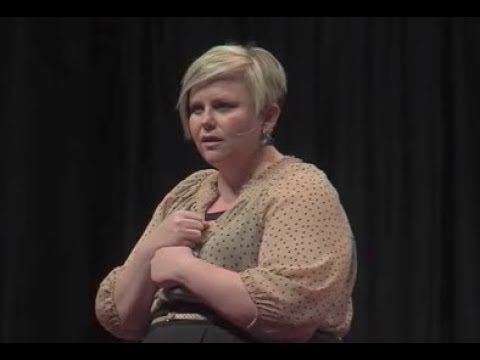
hi everybody my name is Michelle and I
am a feminist I know that the f-word is
a little controversial for some I know
that it makes some people feel
uncomfortable for me though
feminism is really about the Equality of
men and women and I’ve worked in a field
that has been led really by feminist
leaders and it has brought me to this
place
where I really care deeply about men and
boys some people would have you believe
that the term feminism is about tearing
men down that it’s about promoting an
idea of women being superior to men but
I’ve had quite the opposite experience
for 15 years I’ve actually been an
advocate for victims of domestic
violence sexual violence stalking human
trafficking all the stuff that they
listed and I really was taught that the
underlying cause of these issues was
related directly to the oppression of
women because the research is
overwhelming in that the vast majority
of people who are victimized in those
crimes are in fact women and the
research is also really clear that the
vast majority of those who perpetrate
those crimes are men but I want to be
very very clear about something
the vast majority of men are not
perpetrating these crimes in fact it’s
just a small percentage of men who were
doing a great deal of harm so after
years of working with victims I had the
opportunity to start working with men
who were perpetrators in these groups
and I started wondering so if we know
that the vast majority of men don’t
perpetrate these crimes what is going on
with the men who do perpetrate these
crimes and so I had mentioned to you
that I had been taught that the
underlying cause was about oppression
but as I sat in these groups I started
noticing that I these patterns and I
thought this is much more complex than
what I had been taught
certainly the oppression of women was a
part of it but there was much more to
the story and so this was a big shift
for me right because I had spent all
this time working for victims and now I
was being asked to understand the
perpetrator so as I listened as I
listened to the stories of these men and
groups I started to hear some patterns
emerge and certainly some of them walked
into the room and they felt very
superior to women they treated me as
such they talked about how they had the
right to be that way because they were
more superior than their partners were
what I was surprised that many of them
actually did not talk about this they
had not been taught those beliefs and so
I was trying to figure out what is going
on with these folks well some of the
things they started describing were many
of them in fact the majority of them
experienced in their childhood an
intense moment of cruelty or trauma like
many of us do right but the added layer
of complexity for these men and the
groups is that they were talking about
when they experienced this trauma or
this incident of cruelty they were being
told that they couldn’t express their
emotions about the event that occurred
so they were being given these messages
as you know as far back as they could
remember that as boys or men they
shouldn’t have or express certain
emotions and so I think in particular
about one guy sticks out for me and he
talked about a time when he was five
years old and he could remember
interrupting an incident where his
father was being abusive to his mother
so he walks in and he’s seeing his mom
being hit and kicked and punched and he
starts to cry right because that’s an
emotionally intense experience and so he
begins to cry and his dad turns to him
and he yells
stop crying this is what’s wrong with
you
your mom has made you weak right think
about that right
think about how hurtful that must have
been to him as a five-year-old painful
because of course the experience of his
dad telling him that is one thing but
also it created this belief in him that
in order to protect his mother from
future incidents of violence he had to
lock his emotions up deep inside he
couldn’t show anybody these emotions
right and then he learned in that moment
that the only acceptable emotion that he
could show as a boy in his household was
anger and so for him and when you get
put when you have an emotionally intense
experience and you aren’t able to
express your emotions in a healthy way
that creates a very tangible bind for
human beings and so for him having this
anger bottle up the anger became rage
and rage is what he took into his first
significant relationship so he grows up
he gets married and he and his wife
errata he talked about a time when they
were at a barbecue and she makes a very
innocent statement to their group of
friends in fact she thought she was
giving him a compliment and she makes
some sort of a statement like yeah he’s
really tough on the outside but he’s
just a soft teddy bear on the inside
right so she feels like she’s being
loving towards her husband well to him
he hears this message and what he heard
her say was you are weak so you can
understand how he would have a reaction
to that idea right after what he had
what occurred in his childhood so when
they get home unfortunately he acts out
of his rage and he becomes abusive to
her and this time he’s the one causing
the cruelty in the pain a mentor of mine
from the family peace initiative program
calls this the river of cruelty so when
you experience a trauma you get placed
in the river by someone else right it’s
not your fault that you experienced the
cruelty but
you were placed in the river by that
person and if you aren’t thrown a life
preserver by someone then you can get
stuck in the river of cruelty and for
him no one came along to say to him it’s
okay for you to express your emotions in
fact it’s important for you to express
your emotions and so then he just passed
the cruelty on down the river and so
that’s one part of it now I don’t say I
don’t talk about his childhood trauma as
a way to excuse or justify the violence
that he perpetrated in his adulthood my
belief is that he was not responsible
for the cruelty that was done to him but
he is responsible for the cruelty that
he passed on to others right so he has
to still be accountable for that but I
think that if we’re going to really
understand how we prevent these
incidents of violence we have to also
understand that childhood trauma part
and that’s the part that I think that’s
been missing the other part of this of
course is our socialization the way that
we we raise boys another pattern that
emerged for me for those groups is that
there seem to be these man rules that
are written and they would top it I was
able to identify some of them I am
certain I do not know all of them but I
was able to identify some of those man
rules and I think at least this was what
they sounded like to me rule number one
always be strong at all costs right and
I think my goodness what pressure we put
on boys to always be strong and always
be tough and how intense that pressure
can be sometimes and I think rule number
two is something like don’t show fear or
sadness because these emotions equal
weakness and in particular I think what
they have been taught is that these
emotions are not only weak but they’re
feminine and the worst thing that they
could be called is feminine
their eyes one of my favorite movies so
I have my disclaimer it’s one of my
favorite movies is the Sandlot are you
with me on this one right it’s a very
quotable movie for those of you who have
not seen it it is a coming-of-age story
about a group of boys and the only thing
that matters more to them than their
friendship is the game of baseball and
so their local Sandlot is their prized
possession well in the scene that I’m
going to talk to you about they come
riding up to their Sandlot and Here Come
their arch-rivals on the on the on their
bicycles right and so they have to be
territorial they have to guard their
Sandlot and so they engage in what I’m
gonna call a verbal battle of the Wits
with each other and it starts out
something like this
our protagonist says watch it jerk and
then the archrival says shut up moron
and then they say fart smeller you scab
eater it gets really bad I’m gonna stop
right there because it actually gets a
lot worse than that just see the movie
google it on YouTube but at the very end
of this exchange our protagonist says he
he completely ends the exchange of words
by saying you play ball like a girl and
it completely stops the argument
completely all the boys go oh because
there is not an insult worse for them
then you play ball like a girl and so I
think again I love this movie I know
there is a place in our culture for
humor but I do have to worry about the
unintended consequences of us you know
sharing messages with boys that the
worst thing you can be is like a girl
because then how do we expect them to
grow up and respect or see girls and
women as their equal if this is so
normalized in our culture that it’s a
running joke and
popular culture okay so rule number one
was always be strong rule number two
show no fear show no weakness I think
that rule number three is you hear
different versions of it but I’ve heard
things like boys will be boys or it’s
just natural for them to be this way
more recently as it has sounded like
it’s just locker room talk I’m gonna try
not to say more about that and I think
not only is this negative to women right
not only does this put more pressure on
women to somehow be more moral than men
or something like that but I think what
a disservice to boys and men right I
don’t know about you guys but the men
and the boys in my life are a lot
smarter than that
and they are really wonderful people who
absolutely can control themselves
and so I think you know not only is this
harmful to girls into women this message
but it is completely a disservice to men
and boys as well so you know I worry
that the impact of that is that we we
have an expectation that somehow boys
and men have to be these emotionless
robots and is that what we really want
not at all right
a friend of ours recently had a Facebook
post and you know how wacky those can
get real fast
and she had said something and there was
a man in the Facebook feed who responded
back to her response and he says
something like well clearly I am more
credible in this argument because I am
divorced from my emotions and so he’s
arguing with her right that because
she’s being emotional she doesn’t have
any credibility in what they are talking
about well I’m gonna give you a quick
oversimplified science lesson it is
really difficult to divorce from your
emotions unless you’re a sociopath
right our emotions are a part of our
healthy brain functioning if a
saber-toothed tiger comes running on the
stage right now I really hope my
emotions kick in and that I either fight
flight or freeze and I’m really hoping
it’s not freeze right and so we need our
emotions everyone needs their emotions
right we have to we need to feel loved
so that we can make connections with
other people and create families and
create communities and so it’s an
important part of our hub healthy
functioning to have emotions and so I’m
not quite sure why we would want 50
percent of our world’s population not
experiencing or not acknowledging those
emotions so I guess what I’m asking you
to do is to join me in challenging these
rules I’m asking you to not have
expectations that boys should be raised
in a way where they’re bigger they’re
badder and they’re tougher than the next
one because where does that stop right
where does that end and where does that
lead us so I would just say to the to
the boys and the men in the audience you
will experience fear and that’s a part
of your humanity and you will experience
sadness and that gives you the
opportunity to reach out and connect
with other human beings and so I’m
hoping that in some someday in the near
future those man rules we look back in
time and we go
what were we thinking boys don’t cry of
course of course boys cry right and that
also we look back and that play like a
girl is just a badge of honor thank you
very much [Applause]