
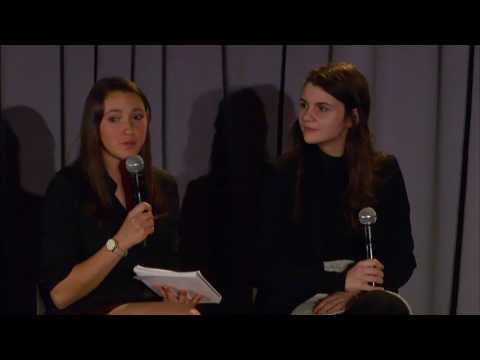
excited about the message that you can
share with our community so I think
going off of Watson’s introduction of
you we just want to hear a little bit
about the services that Chris provides
for refugees and immigrants in Columbus
and a little bit of insight into what
you do sure so thank you so much for
inviting me chris is community refugee
and Immigration Services and we were
founded in nineteen ninety-five our
first office was in the garage at the
Laotian temple on the east side and
we’ve graduated from a garage and now
actually have a building so about 60
employees now aside from the nine that I
had to lay off last week Chris does
refugee resettlement work which means we
help refugees who have come directly
from overseas get settled into their
housing social security office health
screening all those things that need to
happen that first 90 days that a refugee
comes to the US and then after that we
pick up with programs to help people
find jobs learn English we have legal
services program how I got involved in
1998 as a volunteer lawyer and I never
seem to leave so yeah I’ve been I’ve
been there for a while probably oh my
so for a few days I’ve been working
there a few days so where’s the
connection really start with you do you
connect with the refugees and immigrants
before they come to America’s so how
does that start off we do have some
involvement in helping file applications
for people before they come but the way
the processing works is somebody is
forced to leave their home country they
flee to another country and I’ll use the
example of the Bhutanese because I don’t
think many people are aware that
Columbus actually has the largest
Bhutanese Nepali refugee population in
the Bhutanese were forced out in the
early 90s and went to Nepal their new
poly ethnicity and predominantly Hindu
and they then lived in a refugee camp
for almost 20 years it’s the United
Nations High Commissioner for Refugees
job to provide protection and so they’re
in the camp and they sit there and they
sit there and they start businesses and
they start forming a structure for
education and so some of the children
you know get education while they’re
there and the first priority for the UN
is that people repatriate that they go
home that’s the first choice of you know
for any refugee can they go home but
typically that’s not possible so the
second choice then is they would be
integrated into the country that they
fled to so in this case Nepal you know
they speak the language they’re more
culturally similar but Nepal couldn’t
observe them either and so they waited
for 20 years for some international
solution finally the United States said
ok we’ll take 60,000 Bhutanese refugees
over a period of you know six or so
years so they’ve been coming now a
little more than that so actually
getting to the end of that pipeline but
we’re seeing people who are buying
houses now in sort of the blacklick area
so it’s been it’s been great to see
their progress yeah I think I’m one
question that comes to mind people
always wonder how do people from all
around the world end up in Columbus you
know we’re not on either coast we’re
kind of some center of the country how
does that work so with the with the
boonies for example they started out the
first group that came they didn’t know
anybody in the US so the way refugee
resettlement works is then if if
refugees are referred to a third country
for resettlement like the United States
which takes less than one percent of the
world’s refugee population for
resettlement then the people are
allocated based on if they have a family
member already here then they would go
to that location so with the boonies
example they get allocated amongst the
nine
tional resettlement agencies we resettle
for two church world service and
Episcopal migration ministries and those
nine take a percentage of whatever the
annual pool is so was 85,000 last year
so they spread that 85,000 out so those
who don’t have family members just get
put into the pool there are localities
like ours that say well we have capacity
to work with Nepali speakers you know
somali speakers Arabic speakers and so
there’s a grand plan for where people
will go but if they have family already
here then it gets to be kind of a
snowball effect so then they come to
join their family but with the Bhutanese
which is which was also common for
Somalis I mean Columbus became a you
know a hub and a welcoming community and
people tell their friends and they hear
this is a good place to live and work
and they can find service sector jobs
and so you know it becomes a magnet so
so that’s why Columbus ISM is a hub for
a lot of refugees and so you meant it a
little bit the the family connections
people trying to come reunite with their
families how long does that process
usually take so the State Department
reopened a process in fall of 2012 this
is just we’re just talking about
refugees there’s a whole other system
for filing for immigrant visas so we had
many many people filing in in 2012 and
then subsequently so a few of those
folks that filed in 2012 have come so
it’s taking three and a half four years
plus they go through DNA testing to
prove their related to someone here they
go through a series of many interviews
they go through what I’ll call extreme
feting and then they’re able to come
join their family member in the US so I
guess on extreme betting a little bit
where do you kind of where do you see
that going so you’ve mentioned you you
kind of consider what the vetting that’s
already taking place extreme betting so
what kind of things do you think they
could do to make it more extreme it’s
hard for me to know how they could
enhance it further and I was talking to
caroline on the phone and referencing
there was a really well written article
in the
Tim post this week written by Homeland
Security employee who said we already
have extreme vetting I know because I
did it and it we only have a certain
amount of time to talk about all the
steps but there are many many interviews
with many different with Homeland
Security and a State Department
contractor and all kinds of databases
and security clearances and the thing to
know is if there is any doubt the person
won’t be approved to come and going off
of that a little bit so they go through
this process is any of this time
sensitive like what are kind of the
implications of the recent executive
order on on that whole process so as we
talked about this is changing every five
minutes and I peeked at my phone and saw
that so there was the executive order
which you know band arrivals then we had
a court order that throughout parts of
that band piece of that band that was
not thrown out was the the piece that
cut the refugee arrivals in half that
was that still stands but then 10
minutes ago or whenever I saw notice
that that the government has filed an
appeal so it’s all very much in flux
what’s what’s happening right now what’s
with difficult from my perspective is
that I sit across the desk from those
people who filed applications for years
ago and I every day in the parking lot
and trying to get out of my car without
somebody stopping me before you know to
say what’s happening with my case what’s
happening with my case and I’ll say
we’re just we’re just waiting we’re just
waiting and waiting and so you know we
put this process out there for families
to be together and the band was in my
mind not thought through and that it
affected people who were in flight so
I’m
you know seeing I have children and I
have the good fortune of never having
had to live in another country from them
have never had to make the decision to
take one child and have to leave the
other one with Grandma while I try to
make my way and see if i can find safety
with the promise that i can apply for
that child when I you know get to the
United States I’ve never been in that
position and I’m very thankful for that
but I know a lot of people who have been
in that position and they followed the
rules and I sometimes forget because I’m
so immersed in refugee issues that have
to talk about refugee 101 so what
happens in the United States is not like
what’s happening in Europe everybody
every refugee is approved before they
come here they go through this extensive
vetting process that takes at least 18
to 24 months and you may have heard
there was there was an issue with two
Iraqis in Kentucky a few years ago and
the process was slow down and the
wedding was enhanced and it’s been
enhanced and enhanced and I I just from
the way the executive order was
implemented it calls into question how
much how much information is being
gathered from all the State Department
and homeland security people who have
been doing this work for so long you
know that I’m hopeful that there’s that
they’re looking at you know how does
this how does this really work and I
think they’ll they’ll find more
reassurance is once they’ve explored
that yeah I mean we were we were lucky
enough to hear this evening from one of
our own faculty members miss guerito she
told us a bit about her experience and
that she’s sensing in the time that
she’s been in the united states that
attitudes towards immigrants are
changing she felt much more welcome when
she first moved here the perception was
that you know immigrants were people
that were excited to be here and wanted
to work make this country better
contribute and now people are a little
more uncertain they’re not as welcoming
is that something that you feel in the
columbus community is that reflected
here
we’ve certainly been extremely fortunate
with our public officials the mayor and
city council county commissioners have
been extremely welcoming and supportive
for you know many years so we’ve been
lucky in Columbus what I will say is
we’ve seen an outpouring of support of
people who want to be welcome teams we
have many church groups that we work
with our families and people that you
know I like to get personal one-on-one
experiences with families because I
think that’s what changes you know
changes minds and hearts and once you
know someone it’s much harder to to be
afraid of them and I guess going a
little bit more into that can you just
said shed some light on like who’s
coming to columbus who are the people
that you’ve been interacting with like
what is that community look like for you
so last of for fiscal year 2016 which
for us is you know october starts
october one we resettled 833 individuals
and there are three resettlement
agencies in columbus so of our 833 I
think thirty eight percent were
Bhutanese followed next by thirty some
percent Somali and then we had iraqis
some Syrians Congolese Ugandan Eritrea
and Ethiopia and Iranian you know a mix
of people and you know many of the
Iraqis served with the US military
Somalis come and and I I should never
read the reader comments that I see on
but there’s a such a misperception I was
doing a press conference with five of
these moms this week and the comments
say you know none of these people work
and I’ve actually all five of those
women work at least one job and maybe
one or two jobs and they and they you’re
doing jobs that most people don’t want
to do you know they’re they’re doing
housekeeping in hotels and they’re doing
warehouse work you know sometimes we’ll
have somebody who can jump right into
maybe what their background has been but
that’s much harder so when they’re first
hear they got to take any job and get go
so so we have yeah I mean we have a real
real mix of people it’s tough usually
when when people first arrived hard to
find housing for folks who don’t have
any credit history don’t have a job we
give them eleven hundred and twenty-five
dollars per person one time that’s a
federal pass through so that’s their
startup money so if you’re a family of
two that doesn’t go very far by the time
you’ve paid a rent deposit and your
first month’s rent and then single
individuals only get you know limited
amount of assistance and they’ve got to
really get get to work so we’re
fortunate right now the economy is good
so we’ve been able to find jobs pretty
easily work with a lot of big employers
that I’ve got one sugar creek that
provides a vehicle to pick up pick up
refugees in Columbus take them to
washington court house and back again
every day so we yeah yeah so I don’t
think we have too much time left but I
think the last thing we wanted to talk
to you about so the current
administration and supporters of this
travel ban kind of defended saying we’re
making America safer mm-hmm how would
you respond to all of the different
defenses of the travel ban first of all
you have to think about who refugees are
I mean these are people who are running
from terrorists and terrorism so that’s
number one number two we already have
extreme vetting I don’t know how you can
do it more thoroughly they I think they
have the right to take a look at the
system but calling it a pause is really
misleading because we for example have
at least 500 people overseas waiting to
join family members here including very
young children and elderly people who
are not a security threat and the way it
was crafted is you know it’s keeping
these families apart I just it’s not
mutually exclusive that you can have you
know security and compassion at the same
time
thank you so much again for being with
us [Applause]