
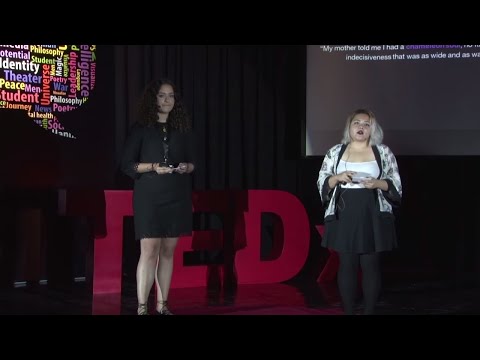
trauma foundation sandy Ramsay is a
self-identified third culture kid she
aspires to create and spread knowledge
and inspire Sandy’s most passionate
about women’s rights and the concept of
identity and homeland she is currently a
student at a student of advertising at
the american university of sharjah as
well as the PR and research coordinator
of speak trauma foundation and we also
have Xena afrah afara a 22 year old
still searching for identity she she
aims to help others with her foolish
abilities her life motto is dum spiro
spero which is latin for when i breathe
i hope she is currently a student of
public relations at the american
university of sharjah as well as
director of visual and audio
storytelling at speak trauma Xena and
sandy you have the floor hello my friend
long time no see she is a morning person
she definitely is not she always picks
up my calls her phone is always off I
contemplate our friendship because I
make you take the stairs yeah but you
can make it up to me if you let me touch
your hair I hate it when people touch my
hair but in all seriousness I’m sandy
I’m Xena my parents are Egyptian really
really Egyptian my dad is Palestinian
and my mom is Filipino but we’re neither
what does that mean what is identity do
I belong to the place my parents are
from can I have more than one identity
what is my identity before my search of
identity I met the founder of speak
trauma Susan Smith she questioned she
sorry she made me question what my
identity was and where I feel like I
belonged she questioned what home was so
when I started meeting new people I
realized he’d ask me really weird
questions like who you are where are you
from what is your nationality and I
thought it was weird like why would they
say something like that why is my
nationality a topic of conversation so
when I used to take cabs a lot most of
our journey was where I’m from where the
cab driver would guess where I’m from
and even when I’m about to pay in the
cashier the research they pop up the
question where are you from a Down am I
taken back by it like okay and I and I
used to be such an accommodating person
I would I would always answer the way
people wanted me to answer so if an Arab
asked me where I was from I tell them a
Palestinian and when an asian asked me
where I was from I tell them I’m a
yes the speak trauma foundation started
with idea out of how trauma destroys
lives and wanted to do something about
it so we live in a culture where if we
say something or we want to say
something we can get judged on it easily
especially if it’s mental issues or
simply if we’re just feeling emotional
so one of the things big trauma does is
that we set up open mic nights with the
help of american university of sharjah
and we give people the opportunity to
speak up and say what they wanted to
feel like they are part of something
they’re part of a community that will
not judge them whatsoever I was very
interested in the work speak trauma was
doing I questioned my identity at a very
young age and finally settled for what i
call the definite unknown it I call that
a third culture kid a TCK author of
third culture kids growing up among
world’s David Pollack explains that a
third culture kid is a person who has
spent a significant amount a part of his
or her developmental years outside their
parent culture in addition he says that
t CK’s build relationships with many
cultures while not having full ownership
of any a cultural hybridity if you will
this hybrida team makes it difficult to
for some to assimilate in their host
countries and may create an inner
conflict this may feel like a hindrance
but we believe that that that this
broadens your horizons and creates
opportunities and experiences otherwise
and available to you as for your
identity there is no rule set in stone
that you have to be from one place or
many places consider how globalization
has played a role in shaping your
identity if you choose to identify with
one place do you think that you are
completely and wholly from that one
place if you’re having trouble answering
that question just consider the clothes
that you’re wearing or the language that
you think in and the languages that you
speak more dominantly a quote I
personally sought comfort in comfort in
the possibility of not knowing
goes like this my mother my mother told
me I have a chameleon soul no fixed
personality just an inner indecisiveness
that was as wide and is wavering as the
ocean sorry for us and many people like
us where we’re a path is set for us by
our families and communities but we’re
like mismatched puzzle pieces 11 of the
same but different so there are times
where I felt I was more Arab and there
were times where I thought I was more
filipino and one thing that my
environment did was they tried to force
me to be loyal to either one of them and
there was only one time where I felt
that I did not one time well there are
times where I only I felt like I didn’t
have to choose which were like Christmas
birthdays and so forth as long as it was
with my immediate family that’s where I
now that I’m older I tell people that
when I tell them that I’m Palestinian
Filipino and they ask me like okay so
Arab or Filipino I’m like I am both this
is my identity this is who I am this is
what makes me me and of course oh well
that’s one interesting part about
identity it makes you curious makes you
want to explore gives you new
perspective in life and so forth and of
course being from two cultures there are
days where I don’t feel like I belong to
either one of them that I’m an outcast
for from both my cultures another thing
as well is that when i say i am half
filipino people tend to stigmatize my
filipino side yes i know they perceive
filipinos as house maids and nannies and
so forth a lot of filipinos that I know
of I’m some people my family are very
well educated and they they they prosper
they’re just some that
and couldn’t find a job in their field
and they had to do something else we all
need to work and it is mentally
exhausting when you’re from two cultures
so if we’re having a conversation and
you ask me where I’m from I always take
a mental step back and always be like I
am half Palestinian i’m half-filipino
but i was born in abu dhabi by group
most of my life in fujairah i don’t
really know much about my Palestinian
side because my dad really talked about
it I’ve only been to philippines about
three times and I’d ever never really
liked it as a young team and I’m now
thinking about it I’m like I don’t
really miss it so yeah I like that look
that’s what goes through my head all the
time I don’t know what to say but now
I’m just like yeah I am Palestinian
Philip you know period and I learned to
control my thoughts I try not to think
about it and not try to think about Oh
which culture what do I feel like I
oh dear okay sorry yeah well for when it
comes to identity there isn’t really a
solution but is there really a solution
we can never fully accept who we are we
are constantly changing so is our
identity it constantly changes I am not
who I was five years ago I’m someone
completely different right so it’s
important to acknowledge that your
identity is not set for you it’s not
necessarily where you’re from either it
can be if you wanted to but it doesn’t
directly apply to everyone else that
being said it doesn’t apply to everyone
else like a formula would because
otherwise it would make my job a lot
easier we struggle with our identity and
the concept of home because we feel like
home is beyond what we can understand it
to be here’s some food for thought have
you ever thought to yourself why a
certain place is considered home to you
is it because it evokes feelings of
happiness comfort and love a place can
evoke those feelings based on your
memories or your perceptions of that
place or even the safeSpace you
attribute to others memories and
perceptions of a certain place so what
do you consider to be home and why one
of our blog posts are our first one
actually in one of our blog posts I
reflected upon my own experience and
coming to terms with my understanding of
home I wrote I’m a hybridized individual
resulting from the marriage of
globalization and the rise of the
digital age beyond the complexity of our
own understanding of home as a construct
or as a place your identity is shape
also by your aspirations and desires
between and aspirations goals and
desires which rests between and beyond
the walls of classrooms following this
we can now talk about that positive
attributes of being a third culture kid
so you learn several languages at it
with whether it be at a native
proficiency or you learn a few words
here and there
like habibi or a mas day you meet lots
of new people as well from various
cultures you become immersed in their
cultures in a way that you become
informed and and form an informed
positive informed point of view and also
this creates an appreciated II this
holistic worldview creates an urge to
know more to see more this is where
travel comes into play a lot of third
culture kids have this heightened sense
of adventure and want to explore beyond
the confines of their comfort zones
another way to Jet Set across the world
without having to commit to travel plans
to travel plans amongst your busy
schedule is through the internet alright
so by a show with a show of hands how
many of you follow travel blogs on
Instagram Facebook Twitter all these
various social media platforms and now
also can you think of two places off the
top of your head that you would like to
travel to just instantly Canary Islands
and Bonnie all right um the internet
helps us dive into our imagination and
creates a thirst for adventure the world
has to offer Peru breeze Tanzania are
all at our fingertips on until we can
physically board a plane and makes make
those dreams a reality not only in this
holistic worldview is beneficial on a
personal and social level is extremely
helpful in academia and thereafter
author Robin Pascal in her book titled
raising global.nomads explaining that
these kinds of people develop a good
understanding of the functioning world
especially in regards to economics
politics technology the environment
culture and general societal issues in
your academic career you will find that
will broaden your scope of knowledge you
will be able to intellectually
understand and build upon pre-existing
ideas but just a heads up though
everything yes everything
is interrelated afterwards many people
progress into the workforce with drive
and motivation you can integrate
smoothly and interact with all kinds of
people who you will encounter throughout
your journey so we shouldn’t force
ourselves to look for our identity do
things you enjoy go out explore or even
just explore with google and you learn
that is how you mold your current
identity and your future identity we
can’t wait to see what you have to offer
the world thank you [Applause]