
I’m not a marine scientists in fact I
started my journey in science as an
aerospace engineer and some of you might
wonder did I get lost along the way
you know but in fact the ocean is the
next frontier let me tell you a story
about how my life had changed very
quickly one day when my advisor in
graduate school and John de Beer II at
Cal Tech came into my office and he
actually came to my office looking
pretty dejected and concerned and he
came up to me and was like hey Connie I
have an idea I can’t seem to sell it to
anyone else in the research group and
you know I’ve asked everyone else in the
group if they would be interested in at
least working on it and I no one’s
interested and and so I was like okay
John what is it let me know what your
what you’re thinking and he said that
you had this idea to study jellyfish
swimming with again jellyfish biologist
jack costello and Inchon : and as most
of you are familiar with jellyfish when
you think about them the very first
thing you think about are its tentacles
right these lovely beautiful things that
extend from the body of a jellyfish or
the Bell when in fact I am more
interested in that Bell
it’s the repetitive motion of the
contraction and the relaxation of these
muscles on this animal that actually
generates forward motion and a common
method that scientists and biologists
have used to try and understand how
animals swim is by using die or die
visualizations and so what you’re seeing
is a pipette actually filled with milk
and it’s the die is placed inside the
seven Brailler cavity of the jellyfish
and as the animals can as the muscles
contract on these animals fluid is
expelled very quickly into the wake of
the animal and so I’m a fluid
mechanician and the thing I get really
excited about are these structures that
are ejected from the body of the animal
these are
called vortex rings how many of you have
flushed a toilet basically if you just
take that whirlpool of fluid you take
the the starting end and the finishing
ending you attach it to each other that
is a vortex ring and so we’ve fluid my
conditions get really excited about
those because all animals when they swim
they generate these more Tex rings as an
engineer what I’m interested in is not
like pretty pictures although they’re
very nice I’m interested in quantities
that I can measure or are used to
understand energetic inputs swimming
efficiencies you know other performance
metrics that are relevant to an
engineered design and so what we had to
do was kind of step up the ante and and
use a technique that’s normally used in
a laboratory to study and measure the
velocity of fluid that is due to an
animal swimming and so this is an
example what a setup would look like in
the laboratory and in order to study a
motion of fluid obviously we need a tank
and within this tank you can place
anything you want it could be an animal
it could be anything that you’re
interested in and unfortunately with
water right it’s transparent so you have
to add particles that are suspended in
the water column or in the tank and so
by motion of these particles you can
actually infer motion of fluid all right
so that you have now particles you have
fluid but now you need something to
illuminate it and so I get the awesome
job of getting to work with lasers okay
I’m an engineer remember I get really
excited about lasers and and so next to
a laser is a high-speed camera some of
these organisms we work with we have to
capture frames at a thousand frames per
second and what we’re then getting are
generating are these consecutive images
of particles moving in time and by using
that information we can get to following
so what you’re seeing is a velocity
field that was measured around a
jellyfish known as phyla Raisa in a
laboratory and so what you have it’s a
little difficult to see but in the
background of this image you have these
white particles right so those are the
part
apples that have actually been added to
this tank and then what the arrows
represent is the direction and speed
that the fluid is moving due to this
animal swimming and so here the arrow
heads can indicate direction and the
color actually from blue to red
indicates low to high speeds and still
using this information we can then back
out those quantities that I’m interested
in as an engineer you’re faced with this
challenge of trying to work on animals
and using these sorts of techniques but
in limited environments right and so one
of the things that I spent my first
three years in graduate school working
on was developing a way to miniaturize
these very complex laboratory
measurements and as something a single
scuba diver can use right and here is
the solution
it’s the self-contained underwater
velocity matreya paratus or scuba and so
what it is is essentially is here you
have a video camera housing and this is
actually all consumer based product
right attached to the camera housing you
have these HID lights which provide
white light so when you’re diving you
can actually see what you’re doing and
then attach to the camera housing is a
laser housing and so in combination with
this a single scuba diver can swim to
whatever target they’re interested in
and get these kinds of measurements so
that could be an animal that could be
flow over a coral reef that could be
measuring filtration rates of sponges to
try and monitor health and so what this
means is then we now open up the world
of these velocity measurements from the
laboratory into anything we want in the
field and so this here is a video just
kind of put you in this team you know
frame of mind I am when I’m doing these
measurements so this obviously these
measurements had to be done at night
because you are using a laser and these
green lights indicate separate divers in
the water column I just need to point
out that that’s me and we’re right now
in the Adriatic Sea we’re about 100 feet
in depth and you’re also
far away from shore I mean so the first
thing we do is turn on these white
lights and we get some very simple data
on trying to understand how fast these
animals swim what is their behavior and
this particular jellyfish called cell
missus is very different in that when
they swim around their tentacles are
located in front of their body instead
of behind it and then once we get that
data we then turn off those white lights
and then turn on the laser and when that
happens it’s magic because what you can
see right are these particle
displacements and that’s solely due to
this animal swimming all right so now we
have this really awesome tool and a
question that I became really interested
in very soon after developing this was
something that was really relevant not
only to the biology but also to the
environment that these organisms live in
and it’s related to the general
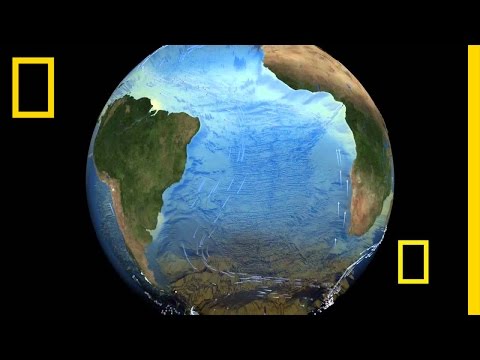
circulation of the oceans and so this is
a simulation conducted by NASA that
shows the the general circulation or the
general currents that go on on in our
oceans and you’ll notice very quickly
it’s not just a single ocean that has
currents it it’s global it’s everywhere
these oceans are all connected and now
oceanographers have spent a lot of time
trying to understand these currents and
also understand how do we maintain these
currents right external power or
external source of energy must be added
to our ocean system in order to maintain
it and then another aspect of the work
is one trying to understand how much of
this energy is required to maintain
these currents and then – what are these
sources of energy and so when we think
about this and this is a widely accepted
idea in the oceanographic community is
that winds and tides make up the
majority of the energetic inputs to
ocean mixing but a recent idea and trust
me it’s very unpopular with the
oceanographic community is whether or
not swimming animals migrating and mass
will have an
impact on the fluid environment be able
to contribute to mixing in the oceans
and it’s not my idea in fact it was
first proposed by famous oceanographer
Walter Munk was at least mentioned and
in myself and some other scientists that
have become very interested in this idea
believe that there is a potential for
this to occur because of the vast number
of organisms in the ocean so the diurnal
vertical migrations that happen in the
ocean every single day are the largest
biomass movement of organisms on our
planet and we don’t know that much about
them so Mark Baumgartner was very kind
enough to allow me to use his his image
that shows the motion of copepods in the
fluid column so how many of you know
what a copepod is Wow okay
even less so do you know that couple
pods are known as the ants of the ocean
okay largest biomass and actually on the
planet so the reason why these animals
migrate is is they do so to avoid being
eaten these organisms because they’re so
small this includes copepods as well as
other small fish they stay down in the
depths of the ocean and then during the
day and then at night go up to the
surface to feed and then once they’re
done feeding they then return to the
depths of the ocean and repeat the cycle
okay this is a daily cycle and so if we
think about how small copepods are so
they’re about a millimeter in diameter
this is a pencil tip one of the things i
want to point out is that these
organisms at least in this example are
migrating 150 meters each way and there
are reports of these animals migrating
anywhere between 200 meters to 500
meters in each direction now why is this
important it’s because these animals
they’re so small in one day the relative
distance that a wildebeest migrates in a
year is the same distance these couple
pods traverse every single day
and we don’t know anything about it we
don’t know much about it and so it’s not
just copepods that do this it’s also
includes krill krill are obviously eaten
by whales but then also jellyfish
jellyfish also vertically migrate and in
fact so missus that one animal I showed
you an Adriatic has been known to travel
one kilometer in each direction and so
my contribution to this biogenic mixing
work is trying to identify how these
animals actually mix water and so what
you see here again in this dive
visualization this is a Palau and
jellyfish known as Miss studious and
what you can see with the dye
visualizations are two different things
so one you have with every contraction
and relaxation cycle you have again
these sexy structures called vortex
rings in the wake but then right behind
the organism what you also see is this
large volume of fluid that’s being
dragged along behind its body it’s being
drifted along and it’s this mechanism
that can allow for large-scale mixing by
these migrating organisms what I want to
tell you is a little bit about where
these studies are going it’s not just in
the topic of biogenic mixing it also
applies to other fields entirely these
fields include obviously oceanography
ecology and biology and engineering in
oceanography there’s this idea that you
know if swimming animals are
contributing to our currents isn’t that
something we should know so there are
scientists looking into that including
myself in biology or in ecology there’s
this idea that if these animals are
migrating from nutrient-rich fluid up to
the surface to feed which can be
nutrient poor and they’re transporting
all of this fluid upwards they’re
actually able to fertilize their feeding
grounds crazy and then in engineering
this is something that’s really near and
dear to my heart in fact I’m doing some
work in this area now is trying to learn
from the biology to design something
that we can use under water or in
anything and so just to say and
summarize all these ideas and that the
frontiers of science right now lies in
the intersections of these fields and it
requires
you know thinkers people from other
disciplines to work together and figure
out ways to communicate with each other
to really be able to answer these
difficult and challenging problems I
want to leave you with an idea a
question and there is no way we’re gonna
answer this tonight but the question is
can swimming animals affect our world
I’m so imagine you know what if the
whales decided to stop swimming or what
if somehow unfortunately they get
removed from the ocean you know how do
you think that’s going to affect what’s
going on not only in the biology but
also it’s happening physically to our
world what happens if we remove apex
predators in our oceans right these
animals these small animals that are
vertically migrating they’re doing it
because they’re avoiding being eaten so
if you move those predators what if they
don’t continue vertically migrating and
then if these animals aren’t migrating
what happens if you don’t have this
fertilization of you know the food base
in the web in the ocean and and so these
are concepts that we really need to
think about you know it’s the big
picture ideas it’s it’s really
understanding how things are connected
in the ocean on on on the surface on
land and in in our planet and so I think
it’s a very exciting time because I
think technology is caught up and we’re
finally going to be able to answer these
really big questions thank you
you
Please follow and like us: